
Strategy 8 min April 16, 2026 Updated May 21, 2026
'I Tried Direct Mail Before and It Didn't Work': Here's What Actually Happened

Brayden Fielding
CEO, Tree Traction
Brayden Fielding
CEO, Tree Traction
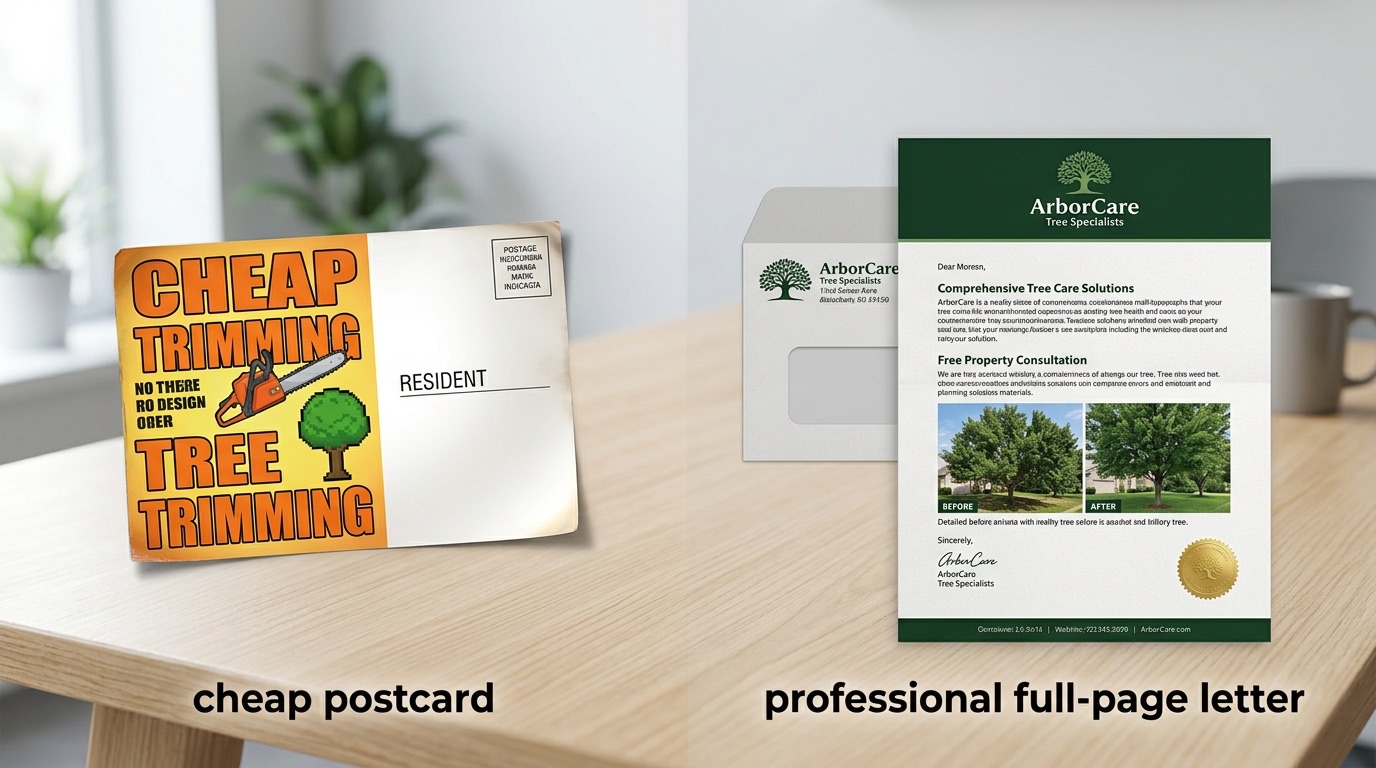
“I tried direct mail before and it didn’t work.”
This is the most common objection we hear on sales calls. And it’s almost always true, the campaign they ran didn’t work. What they’re wrong about is why.
It wasn’t direct mail that failed them. It was the specific version of direct mail they ran. And there’s a meaningful difference.
When a tree service owner says direct mail didn’t work, the campaign they’re describing almost always has one or more of these characteristics:
Postcards, not letters. Postcards are cheap and easy. They’re also the wrong format for tree service. A postcard sits in a stack of mail, gets scanned in 2 seconds, and hits the recycling bin. A full-size 8.5x11 handwritten-style letter gets held, read, and often kept on the kitchen counter for days. Response rates for full-size letters are consistently 3-5x higher for home services than postcards.
No route selection, just blanket EDDM. Every Door Direct Mail sends to every address on a route: renters, apartments, homeowners who just planted a tree last year, commercial buildings, empty lots. It doesn’t filter for high-income homeowners with mature trees. The response rate from an unfiltered route is predictably low because most of the people receiving it aren’t your customer.
One or two drops, then done. Direct mail research consistently shows that homeowners respond after seeing a message 3-7 times. One drop generates some calls, but not from the homeowners who need more exposure before they pick up the phone. Companies that mail once and quit miss the 60-70% of the audience that was getting warmer and closer to calling.
No tracking. If you don’t know which neighborhoods generated calls and which ones didn’t, you can’t cut the dead routes and double down on the winners. Without tracking, every month is month 1, same coverage, same results, no improvement. Results stay flat forever.
Wrong message. “We’ll be in your area next week” is the most overused tree service mailer line. Homeowners have seen it a hundred times from a hundred different companies. Generic messaging produces generic results.
Fix any two of those five problems and you’re looking at a different campaign with meaningfully different results.
Let’s talk about the two most common scenarios.
Scenario A: The one-shot campaign. Owner mails 5,000 pieces to a zip code in March, gets 7 calls, closes 3 jobs. Decides the ROI wasn’t there and doesn’t mail again. Conclusion: “direct mail doesn’t work for me.”
What actually happened: 7 calls from 5,000 pieces is a 0.14% response rate, low, but not unusual for a first drop with no prior brand presence. The problem is that mail compounds. Drop 2 would have produced 9-11 calls as homeowners started recognizing the name. Drop 3 would have pushed it to 12-14. By drop 5, the same budget would have generated 18-22 calls because the audience was warmed up. But the campaign ended after one drop, before any of that could happen.
Scenario B: The cheap option. Owner used a low-cost provider (Leaf Leads, a local printer, or DIY EDDM) at $0.40/piece. Got some calls, couldn’t track where they came from, didn’t know which routes were working. Tried to optimize and couldn’t because there was no data. Stopped.
What actually happened: Without route-level tracking, there was no way to identify that 3 of the 8 routes were producing 80% of the calls. The other 5 routes were wasted spend. Cut those 5 routes, concentrate budget on the 3 producers, and the economics flip. But without tracking data, that optimization is invisible. The campaign wasn’t failing, the measurement was.
A direct mail campaign with route-level tracking looks fundamentally different from the campaigns most owners have tried.
Route selection is data-driven. Before a letter goes out, we’ve analyzed 295 data points per carrier route, including satellite tree density, canopy health, homeowner income, property values, and property size. We’re not blanketing neighborhoods. We’re targeting the specific carrier routes in your market where the combination of trees and money is highest. That’s why the first drop performs better than a random zip code blast.
Tracking is granular. Every carrier route gets its own unique local-area-code phone number, all forwarding to your main line. After 30 days, you know that Route 14 produced 6 calls and Route 22 produced zero. You don’t have to guess. You cut Route 22 in month 2 and mail more to Route 14.
Format matters. Full-size 8.5x11 letters, printed full color, sent flat, no envelope. The letter looks like it came from a real person in the neighborhood. It gets read. It stays on the counter. Homeowners who aren’t ready to call in month 1 might call in month 3 after seeing it three times.
The commitment matches the mechanism. Direct mail compounds. We recommend a minimum 90-day window before drawing conclusions because that’s how long it takes for the feedback loop to run 2-3 full cycles. By month 3, you’ve cut dead routes and you’re mailing more to your best performers. That’s when the economics start to visibly improve.
This objection comes up. And it’s fair, there are people for whom direct mail, even well-run, hasn’t delivered great results. A few honest reasons that can happen:
Market saturation in a specific neighborhood. If six tree services are already mailing the same routes, your letter competes for attention. We track who else is mailing where and route around saturation.
Weak conversion after the call. The lead comes in but the estimate doesn’t close. This happens when the business isn’t presenting professionally, isn’t following up on quotes, or has pricing out of sync with their market. Direct mail delivers the call, what happens next is on you. Tree Traction is designed to amplify what’s already working, not fix a broken sales process.
Wrong service area. Some markets have demographics that are difficult for high-ticket tree service, low homeowner rates, low income levels, limited tree coverage. Our analysis catches most of these before we recommend routes, but no market is guaranteed.
These are real edge cases. The overwhelming pattern is that well-run, properly-tracked, consistently-mailed campaigns produce better results than anything else in tree service marketing.
If your previous experience with direct mail checks any of these boxes, you haven’t run a fair test yet:
Run a campaign without those problems for 90 days, with route-level data and a real feedback loop, and you’ll be evaluating a completely different product.
See the ROI math from clients who made the switch. Or compare what targeted direct mail looks like vs. EDDM if you’ve only run blanket campaigns before.
If you’re still skeptical, that’s fine, bring the skepticism to a call. We’ll map out the routes in your area and show you the data before you commit to anything. Schedule here.
Ready to grow into the neighborhoods you want?
250+ tree companies use Tree Traction. See if your zip code is available.
Book a Free Strategy CallFREQUENTLY ASKED QUESTIONS
The most common reasons: wrong targeting (blanketing an entire zip code instead of selecting routes by tree density and income), no tracking (so you couldn't tell what generated calls and what didn't), running it for too short a time (one drop doesn't build the compounding data that makes mail improve), and using postcards instead of full-size letters (which get 3-5x lower response rates for tree service). Most 'failed' direct mail campaigns had one or more of these problems.
EDDM (Every Door Direct Mail) delivers to every address on a route: renters, apartments, empty lots, and homeowners alike. Targeted direct mail selects routes based on data: tree density, homeowner income, property values, and property size. You're not mailing everyone. You're mailing the households most likely to need and afford professional tree service. That difference can triple your response rate.
Expect calls starting with your first drop, but don't evaluate the campaign on one drop. Direct mail research shows that homeowners typically respond after seeing a mailer 3-7 times. Consistent monthly mailing to the same routes builds familiarity and trust that makes each subsequent drop more effective. One-shot campaigns almost always underperform sustained campaigns.
Full-size 8.5x11 letters (not postcards) with a handwritten-style element, professional full-color design, a specific offer or call to action, and a local phone number. Postcards have lower perceived value and get discarded faster. Letters that look like they came from a real person in the neighborhood produce significantly higher response rates.
Yes, with different conditions. If your previous campaign used postcards, blanketed an entire zip without data-based route selection, ran for one or two months, and had no per-route call tracking, those are fixable problems. A properly structured campaign with route-level targeting, full-size letter format, call tracking, and at least a 90-day commitment looks nothing like the campaign that 'didn't work.'
About the Author
Brayden Fielding
CEO, Tree Traction
Brayden Fielding is the founder and CEO of Tree Traction, the only direct mail company in the U.S. built exclusively for tree service businesses. He's worked with 200+ tree service companies across the country, studying what makes direct mail campaigns produce real revenue (and what makes them flop). When he's not digging into route-level data or reviewing campaign results, he's talking to tree service owners about what's actually working in their markets.
KEEP READING
Local SEO for tree service companies: how to rank in Google Maps, build your Google Business Profile, earn reviews, and get found before competitors.
Which videos generate tree service leads and which waste your time. A no-fluff guide to tree service video marketing that actually produces calls in 2026.
Tree service Google Ads vs direct mail: real cost breakdowns, close rate math, and when each channel actually wins for your budget.
Book a free strategy call — 30 minutes, no obligation.
Book a Free Strategy Call