
Operations 7 min March 1, 2026 Updated May 22, 2026
How to Get Back-to-Back Tree Service Estimates in the Same Neighborhood

Brayden Fielding
CEO, Tree Traction
Brayden Fielding
CEO, Tree Traction
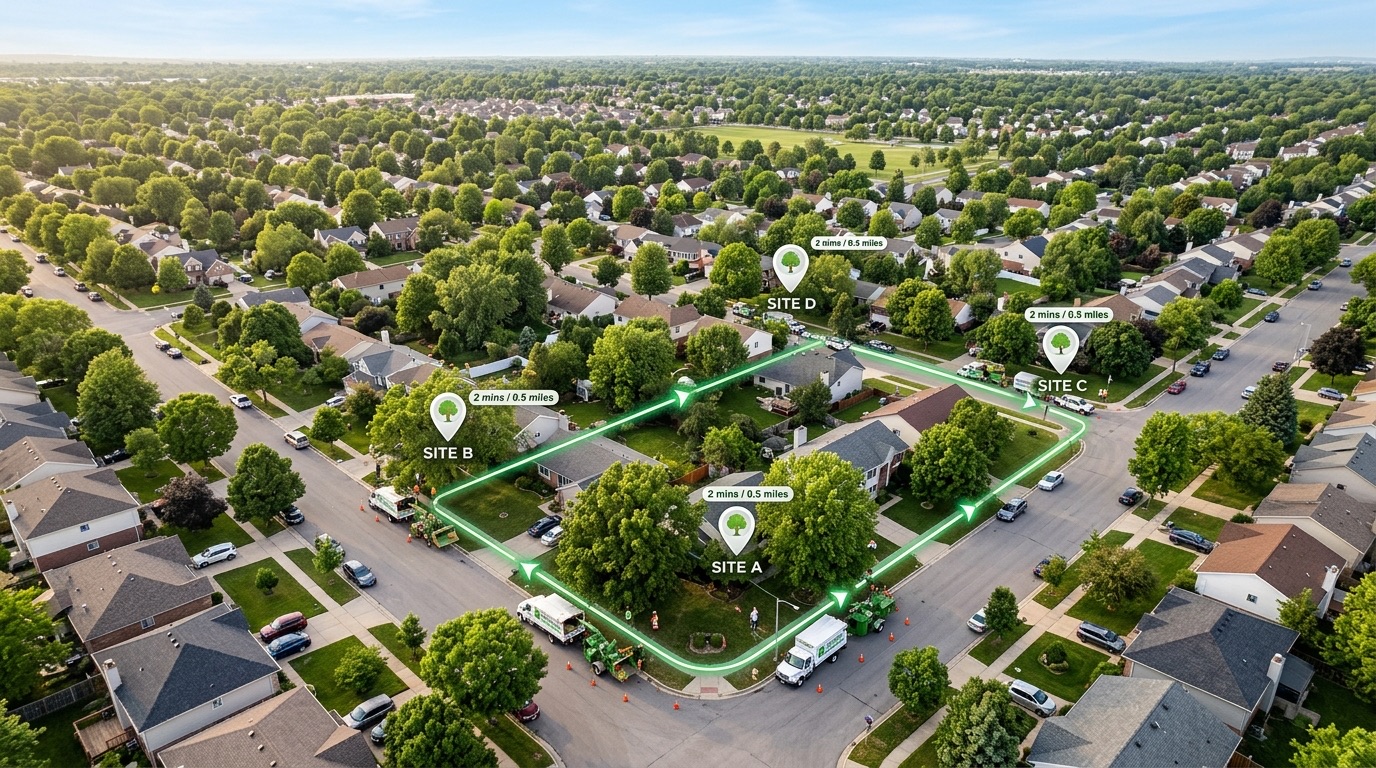
Matt Morovic with Upright Tree Care in Wisconsin runs 5 estimates in 2 hours. Not because he’s rushing. Because they’re all in the same neighborhood.
That’s not luck. That’s what happens when your leads cluster geographically instead of scattering across your entire service area.
Now think about your average day. One estimate on the north side at 9 AM. Drive 35 minutes downtown for the next one. Crew’s waiting on the east side because a job ran late, and now they’re burning an hour of drive time before the next site. You did real work for maybe 5 of those 9 hours. The rest was windshield time.
Sound familiar?
The difference between those two days, in revenue, in margins, in sanity, is enormous. And the fix isn’t hiring a better dispatcher or buying scheduling software. It’s getting your leads to cluster geographically in the first place.
Here’s the thing. Google LSA, Angi, Thumbtack, Facebook. None of these platforms care where your leads come from. They route calls based on who’s searching, which is random across your whole market.
A homeowner searches “tree removal near me” and Google sends you the lead. That homeowner could be 5 minutes from your shop or 45 minutes away. Google doesn’t know. Google doesn’t care. Angi’s even worse. They sell the same lead to 3-5 contractors, and none of you have any control over where the job is.
Facebook? You can target by zip code, but the people clicking your ad aren’t looking for tree work. They’re scrolling and tapped something. The “leads” you get are scattered, low-intent, and half of them want free wood or a $100 trim. Meta’s AI-optimized campaigns have made this worse through 2024-2025, with multiple tree service owners reporting lead costs tripling while close rates dropped.
Result: your estimates are scattered across the map. You spend as much time driving as working. And your revenue per truck stays flat because half your day is unproductive drive time.
Direct mail is the only marketing channel where you choose exactly where your calls come from. Before anyone picks up the phone.
When you mail 15 carrier routes in a 4-mile radius of a high-value neighborhood, the calls you get come from that 4-mile radius. The calls cluster because the mail clustered. It’s that simple.
Your estimator runs a route, not a scavenger hunt. Four estimates in the same subdivision in one afternoon. Matt Morovic does five in two hours. That’s the kind of efficiency that changes your entire daily revenue number.
Your crew follows right behind. Shorter drives between jobs. More jobs completed per day. Lower fuel cost per job. If your crew is spending 90 minutes a day driving between job sites (which is average for tree services without geographic concentration), cutting that to 30 minutes gives you a full extra hour of billable work. Every single day.
Word of mouth compounds locally. This is the part most people miss. When neighbors see your truck parked on their street, your crew working two doors down, your yard signs at three houses on the same block, you start getting calls that had nothing to do with your mailer. That’s free business from proximity alone. One tree service owner told us he got four referral calls in a single week from a neighborhood he’d been mailing for three months. None of those calls cost him a penny.
We use satellite imaging to measure tree density at the individual carrier route level. Nobody else in the country does this.
Why does that matter? Because a zip code is too broad. One zip code might have a subdivision full of mature oaks on half-acre lots on the north side and a condo development with no trees on the south side. Mailing the whole zip wastes half your budget. Mailing specific carrier routes with verified tree canopy puts every letter in a mailbox that matters.
High-performing neighborhoods for tree service share specific characteristics: mature tree canopy (we’re talking 40-foot-plus trees that actually need professional work), homes valued above $400K in most markets (homeowners who can afford your rates), homeowner-occupied (not rentals), and low saturation from other tree service direct mail. In high cost-of-living metros that threshold runs closer to $500K. In mid-size markets, $350-$400K is typically the sweet spot. The number matters because average job values on our best-performing routes run 30-40% higher than on routes where the home value threshold sits below those marks.
That’s 295 data points per carrier route working for you before a single letter hits a mailbox. Not Google Maps. Not driving around looking for big trees. Actual satellite data and demographic analysis.
Pick your highest-margin job types first. Large removals need big old trees and high property values. Trimming and maintenance needs dense residential areas with homeowners who care about their yards. Know what you’re optimizing for before you pick where to mail. A $15,000 removal job and a $400 trim job require different neighborhoods.
Find geographic concentrations of your ideal neighborhoods. Look for 10-20 routes within a tight radius that score high on your target characteristics. Don’t spread across the whole metro. Concentrate. A common mistake is mailing one route here, two routes there, across 15 different zip codes. That gives you scattered leads, which is the exact problem you’re trying to solve.
Mail the cluster consistently. When the same neighborhoods see your letter 2-3 times over a few months, response rates climb. You’re not just generating calls. You’re building brand recognition in a specific area. Ricky Folse with Veteran Tree Care got 10 calls in 2 days on his first mail drop during the slowest season. By his third drop to the same routes, he was getting calls from people who said they’d been “meaning to call since last month’s letter.”
Track which routes produce and cut the ones that don’t. This is where most direct mail falls apart. If you’re using DIY EDDM or a provider like Leaf Leads that puts one tracking number on everything, you have no idea which routes are carrying the campaign. With route-level tracking, you’ll know within 60 days which routes are producers and which ones are dead weight. Cut the losers. Reinvest in the winners. Your cost per call drops every month.
A tree service in the suburbs of a mid-sized market picked a 6-mile corridor of older neighborhoods. Big trees, high home values, dense canopy. They mailed 22 routes, about 4,800 letters per month at $0.55 per piece. Total spend: roughly $2,640/month.
Month 1: calls came in from about 15 of the 22 routes. Seven routes produced zero calls.
Month 2: they cut the 7 dead routes and added 3 new adjacent routes that matched the characteristics of their top performers.
By month 3, they’d narrowed to 14 routes that were consistently producing. Their estimator was running 4-5 bids per day in a 3-mile radius instead of driving all over the metro.
Monthly revenue from direct mail jobs: up 40% vs. month 1. And they were mailing fewer total pieces. Lower spend, better results, tighter geography. That’s what the feedback loop does when you actually have data to work with.
Geographic clustering doesn’t just improve your marketing metrics. It changes the economics of your entire business.
Your estimator closes more jobs because they can do more bids per day. Your crew generates more revenue per truck because they spend less time on the road. Your fuel costs drop. Your equipment hours are more productive. Your schedule is easier to manage because jobs are grouped, not scattered.
And here’s the long game. When you’ve been mailing the same neighborhoods consistently, you become the tree service those homeowners think of first. Not because of a Google ad. Because your letter has been on their kitchen counter three times. When a storm hits and they need someone fast, they’re not searching Google. They’re calling the number from your letter.
That’s the difference between buying leads one at a time and building a territory.
Every minute your crew spends driving between jobs is a minute they’re not generating revenue. Every estimate you drive 45 minutes to reach is an estimate that costs you twice what it should in time and fuel.
Geographic clustering through targeted direct mail is the most reliable fix for this problem. It’s the only channel that gives you control over where your calls come from before anyone dials your number.
The companies doing this well aren’t just getting more calls. They’re getting more efficient calls. And that difference compounds into significantly better margins, month after month, route after route.
Ready to grow into the neighborhoods you want?
250+ tree companies use Tree Traction. See if your zip code is available.
Book a Free Strategy CallFREQUENTLY ASKED QUESTIONS
Geographic lead clustering is a marketing strategy where you concentrate your outreach in specific neighborhoods so incoming calls are geographically close together. Less drive time between estimates, more jobs per day, better margins. Direct mail is the only channel that gives you this level of control over where your leads come from.
You pick the carrier routes. When you mail 15 routes in a 4-mile radius, the calls you get come from that 4-mile radius. It's that simple. Google LSA and Angi can't do this because they route leads based on who's searching, which is random across your entire service area.
Most successful campaigns start with 10-20 routes within a tight radius that share the same characteristics: mature trees, high home values, homeowner-occupied. After 2-3 months of route-level data, you cut the dead weight and double down on the winners.
Most Tree Traction clients see calls within 2-3 weeks of their first drop. By month 3, you'll have enough data to know which routes are producing and which ones to cut. Clients who stick with it typically see 30-40% better results by month 6 compared to month 1.
About the Author
Brayden Fielding
CEO, Tree Traction
Brayden Fielding is the founder and CEO of Tree Traction, the only direct mail company in the U.S. built exclusively for tree service businesses. He's worked with 200+ tree service companies across the country, studying what makes direct mail campaigns produce real revenue (and what makes them flop). When he's not digging into route-level data or reviewing campaign results, he's talking to tree service owners about what's actually working in their markets.
KEEP READING
Speed to lead decides which tree service wins the job. Here's the math on response time and why a missed mailer call is a lost job, not a callback.
Most tree service owners send a quote and never follow up. A simple tree service lead follow-up system recovers revenue already sitting in your pipeline.
A month-by-month tree service marketing calendar tying the spring rush, summer peak, fall cleanup, and winter dormant season to specific actions and mail volume.
Book a free strategy call — 30 minutes, no obligation.
Book a Free Strategy Call