
Strategy 9 min March 30, 2026 Updated May 22, 2026
Is Direct Mail Worth It for Tree Service Companies? We Did the Math

Brayden Fielding
CEO, Tree Traction
Brayden Fielding
CEO, Tree Traction
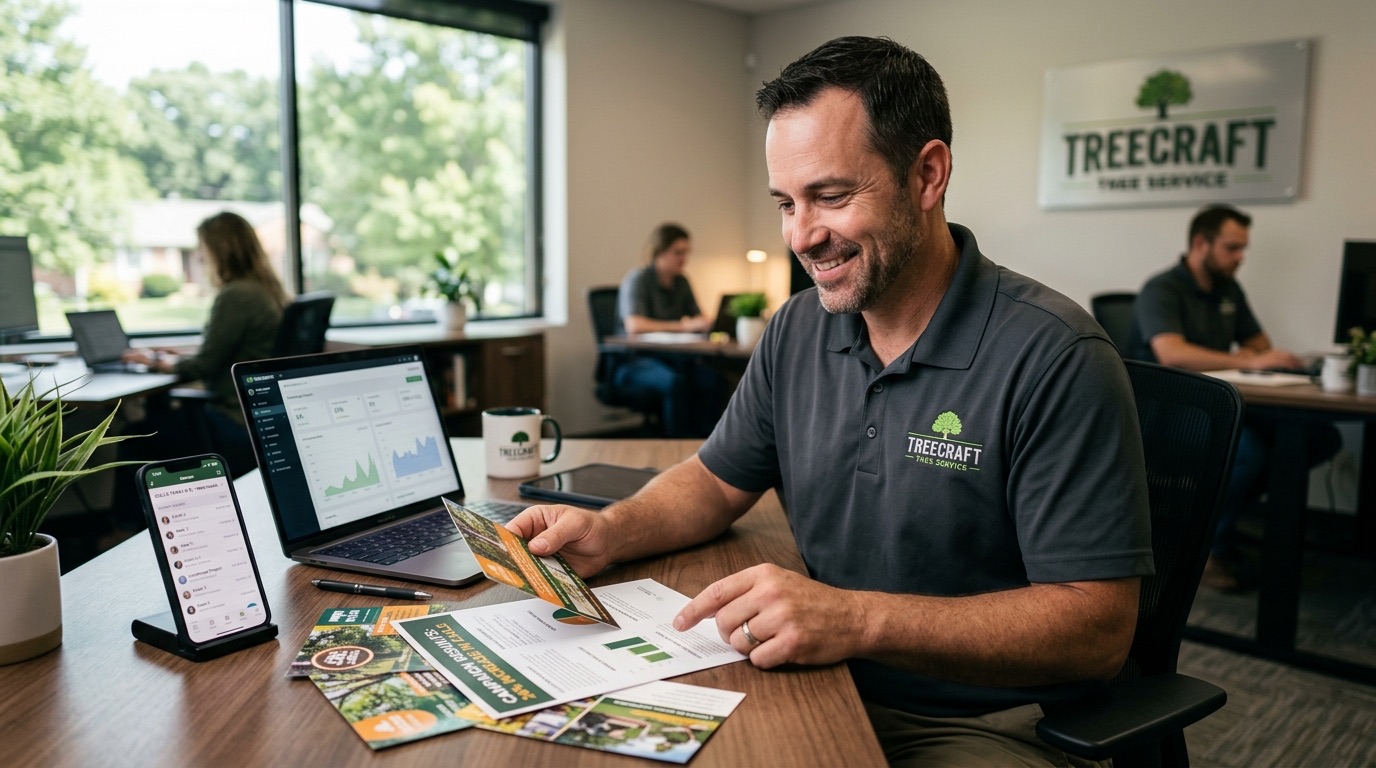
Dayde Collins with Blades Tree Removal spent $3,200 on his first month of direct mail and quoted $47,000 in tree work within 30 days. He’d tried digital marketing. He’d tried agencies. Nothing came close.
But here’s the thing. For every Dayde, there’s a tree service owner who spent $2,000 on postcards two years ago, got two calls, and swore off direct mail forever. Both stories are real. And the difference between them isn’t luck.
It’s math.
We hear this on nearly every sales call: “I tried mailers before and it didn’t work.” It’s the #2 objection we get from tree service owners, right behind price. And honestly? They’re usually right. Their last campaign probably didn’t work.
But “direct mail didn’t work” is like saying “my chainsaw didn’t work” after you tried cutting a 30-inch oak with a dull chain and no bar oil. The tool isn’t the problem. The setup is.
When we dig into why a previous campaign flopped, it’s almost always one of three things:
Fix those three things, and direct mail goes from “waste of money” to “best marketing channel I’ve ever used.” We’ve seen it happen hundreds of times across 200+ tree service companies.
Let’s get specific. A Growth plan at Tree Traction runs about $3,200/month for approximately 4,600 handwritten-style letters across two mailings. Here’s what the math looks like based on real campaign data.
At a conservative 0.5-0.7% response rate (which is typical for well-targeted tree service direct mail), that’s 25-35 inbound calls per month from homeowners in your service area. These aren’t shared leads. These aren’t people who also called four other companies. They picked up your letter, saw your number, and called you.
Of those 25-35 calls, 95% book an estimate. A tree service company typically closes 35-65% of those estimates into booked jobs — averaging around 50%. That’s 12-17 new jobs per month. With Tree Traction’s average job value running $1,500-$2,000, you’re looking at $18,000-$34,000 in closed revenue from a $3,200 investment.
That’s not theory. Alissa Tooley with A&J Specialties quoted $160,800 in her first three months and closed $69,200. She was consistently pulling $40,000/month in revenue from mailer leads alone. Her investment? About $3,200/month.
Sound too good to be true? The key word is “well-targeted.” And that’s where most campaigns fall apart.
Here’s where the math gets interesting. Let’s take that same $3,200 monthly budget and see what it buys on other channels.
Google Ads/LSA: At $10-25 per click (typical for tree service keywords in 2026), $3,200 buys you 128-320 clicks. At a 10-15% conversion rate, that’s 13-48 leads.
Sounds decent until you factor in two realities. First, Google’s “Get Competitive Quotes” feature sends the same lead to 3-5 tree services simultaneously, so the homeowner is price shopping before you even answer. Second, Google’s April 2025 TOS update claimed ownership of LSA ad assets, meaning the performance data you build on their platform isn’t yours to take if you ever pause or switch. You’re bidding against every other company in town, and you own nothing you’ve built.
Your close rate on those shared leads drops to 15-25%. Real jobs booked? Maybe 3-12. And the algorithm could tank your results tomorrow with zero recourse.
Angi: At $25-85 per lead, $3,200 gets you 38-128 leads. But 70% of Angi leads are unqualified per contractor reviews (BBB rating: 1.08/5 for a reason). So you’re looking at 11-38 real prospects.
Each one also went to 3-5 other tree companies. You’re driving across town for estimates where the homeowner already has four cheaper quotes. Close rate on Angi leads? Maybe 10-20%. Jobs booked: 1-8.
Facebook Ads: Lead costs have tripled for many home service advertisers since 2024 and the deterioration continued into 2025-2026, driven by Meta’s shift to AI-optimized Advantage+ campaigns that remove advertiser control over targeting. At $15-40 per lead (when it works), $3,200 gets you 80-213 leads. But Facebook leads are people who weren’t looking for tree service.
They were scrolling and tapped a button. Half won’t answer the phone. The ones who do are often looking for free wood, $150 trim jobs, or “just getting prices.” Realistic close rate: 5-15%. Jobs booked: 4-32, but job values skew much lower because you’re attracting price shoppers and tire kickers.
Direct mail ($3,200 at Tree Traction): 25-35 exclusive calls from homeowners who called only you. 95% book estimates. Close rate: 35-65%. Jobs booked: 8-21. Average job value: $1,500-$2,000, because you’re reaching homeowners in neighborhoods selected for income and property value, not competing on price.
Dollar for dollar, it’s not close.
Let’s go back to that skepticism for a second. If you spent $2,000 on postcards and got two calls, that’s a real experience. Nobody’s dismissing that.
But what if those postcards went to carrier routes with 60% renters? What if the design looked identical to three other tree service mailers that hit the same mailboxes that week? What if you had one tracking number, so you had no idea whether 100% of your calls came from one route or were spread across all of them?
That’s not a direct mail failure. That’s a targeting and tracking failure.
Here’s what we know from running 200+ tree service campaigns: 75% of all calls come from just 50% of the routes mailed. The other half of your routes? Nearly silent. If you don’t have route-level tracking with a unique phone number on every single carrier route, you’re paying to mail those dead routes forever. And you’ll never know which half is working.
That’s the difference between sending mail and running a direct mail system. One stays flat. The other gets better every month.
We’re not going to pretend direct mail is magic. There are situations where it’s not the right fit, and being honest about that is more useful than promising the world.
Your average job value is under $800. The math doesn’t work if you’re mostly doing $300-$500 trim jobs. Direct mail shines when your average job is $1,000+ because the return on a $3,200/month investment compounds faster with larger tickets. Removals, large pruning jobs, stump grinds, crane work, and lot clearing are where the ROI gets obvious.
You can’t close leads. Direct mail puts the phone in your hand. If your estimating process is weak, your pricing is all over the place, or you’re not answering the phone when it rings, more leads won’t fix a sales problem. Tree Traction amplifies what’s already working. It doesn’t fix a broken operation.
Your market is saturated with mailers and you’re not willing to differentiate. If three other tree companies are already mailing the same neighborhoods with generic postcards, you need to stand out. A custom-designed, full-size handwritten letter looks and feels different than a postcard. But if you insist on using the same tired template everyone else sends, you’re adding to the noise instead of cutting through it.
You only want to try it for one month. Direct mail compounds. Month one is data collection. Month two, you cut underperforming routes and double down on winners. By month three, your cost per lead is dropping and your ROI is climbing. One month is a coin flip. Three months is a system.
This is the part that separates direct mail from every other marketing channel for tree services. Google Ads don’t get cheaper the longer you run them. Angi leads don’t get more exclusive over time. Facebook doesn’t send you higher-quality prospects in month six versus month one.
Direct mail does. But only if you’re tracking at the route level.
Here’s how it works. Month one, you mail 4,600 letters across, say, 8-10 carrier routes. Each route has its own tracking phone number. At the end of the month, your dashboard shows you exactly which routes produced calls and which ones sat there doing nothing.
Month two, you cut the 3-4 dead routes and replace them with new ones (selected using 295 data points per route, including satellite tree density data that clusters your leads geographically). Your budget stays the same but now it’s concentrated on routes that actually produce.
By month three, you’ve got a refined list of your best-performing neighborhoods. Your customer acquisition cost is dropping. Your call volume is rising. And you’re getting 3-4 estimates in the same neighborhood instead of driving an hour between bids.
Matt Morovic with Upright Tree Care in Wisconsin 10x’d his marketing spend in his first month. He was doing 5 estimates in 2 hours because they were all in the same neighborhood. That’s not a marketing result. That’s an operational transformation.
If you’ve been burned before and you’re willing to try again (with the right setup this time), here’s what separates a campaign that works from one that wastes your money.
Route-level call tracking. Not one number for your whole campaign. Not one number per zip code. A unique tracking phone number on every single carrier route, so you know exactly which neighborhoods produce calls. This is non-negotiable. Without it, you’re guessing. Forever.
Data-driven targeting. Your mail should go to neighborhoods selected based on income, property value, homeowner age, and tree density. Not gut instinct. Not “my buddy said that neighborhood has money.” Real data. We use 295 data points per carrier route including satellite tree density analysis that no one else in the country has.
Custom design that stands out. A full-size 8.5x11 handwritten-style letter sent flat (no envelope) gets noticed. A 4x6 postcard that looks like it came from a coupon book gets thrown away. Your mailer has to earn 3 seconds of attention, and design is what buys those seconds.
Monthly consistency. One blast is a gamble. Monthly mailings build recognition in your target neighborhoods. The homeowner who throws away your letter in March might need a removal in June. If you’ve been in their mailbox three times by then, you’re the company they call.
Ownership of your data. You should own every phone number, every route insight, every piece of campaign data. If you leave a vendor and lose all your tracking numbers and call history, you were renting leads, not building an asset. That’s a critical difference when you’re investing $3,200 a month.
Let’s bring it back to the math.
A tree service spending $3,200/month on well-targeted direct mail, tracked at the route level, with a professional design and monthly consistency, should expect to generate $15,000-$40,000+ in closed revenue per month by month three. That’s a 4-8x return that improves over time, not a flat line.
Compare that to Google LSA where the algorithm controls your fate, Angi where every lead goes to five companies, or Facebook where half your leads want free firewood. Direct mail isn’t the cheapest option. But dollar for dollar, it’s the most predictable, most exclusive, and most controllable marketing channel a tree service company can run.
The question isn’t really “is direct mail worth it?” The question is whether your last attempt had the right targeting, the right tracking, and the right design. If it didn’t, you didn’t really try direct mail. You tried sending paper to random addresses and hoping.
There’s a difference.
Want to see which carrier routes make sense in your market? We’ll map it out for free.
Ready to grow into the neighborhoods you want?
250+ tree companies use Tree Traction. See if your zip code is available.
Book a Free Strategy CallFREQUENTLY ASKED QUESTIONS
Yes. Direct mail averages a 4.4% response rate versus 0.12% for email, and produces an average ROI of 161% across industries. For tree services specifically, a well-targeted $3,200/month campaign typically generates 25-45 calls per month and $15,000-$40,000+ in closed revenue.
A professional direct mail campaign for a tree service typically runs $3,200/month for about 4,600 letters across two mailings. Per-piece costs range from $0.52 to $0.70 depending on volume. This includes design, printing, targeting, postage, and route-level call tracking.
Most failed tree service mailers share three problems: wrong neighborhoods (no targeting data), no call tracking (so you can't tell what worked), and generic designs that look like every other mailer in the mailbox. Without route-level tracking, you keep mailing the same dead routes month after month.
Based on data from 200+ tree service campaigns, a well-run direct mail program typically produces 4-8x return on spend by month three. First-month results vary, but the compounding effect of cutting underperforming routes means ROI improves every month rather than staying flat.
They work differently. Google captures people already searching for tree service. Direct mail creates demand by reaching homeowners before they search, which means you're the only tree company they call. Direct mail leads tend to close at higher rates because there's no competing quote from four other companies.
About the Author
Brayden Fielding
CEO, Tree Traction
Brayden Fielding is the founder and CEO of Tree Traction, the only direct mail company in the U.S. built exclusively for tree service businesses. He's worked with 200+ tree service companies across the country, studying what makes direct mail campaigns produce real revenue (and what makes them flop). When he's not digging into route-level data or reviewing campaign results, he's talking to tree service owners about what's actually working in their markets.
KEEP READING
Local SEO for tree service companies: how to rank in Google Maps, build your Google Business Profile, earn reviews, and get found before competitors.
Which videos generate tree service leads and which waste your time. A no-fluff guide to tree service video marketing that actually produces calls in 2026.
Tree service Google Ads vs direct mail: real cost breakdowns, close rate math, and when each channel actually wins for your budget.
Book a free strategy call — 30 minutes, no obligation.
Book a Free Strategy Call