
Strategy 7 min April 16, 2026 Updated May 21, 2026
How Often Should a Tree Service Company Send Direct Mail?

Brayden Fielding
CEO, Tree Traction
Brayden Fielding
CEO, Tree Traction
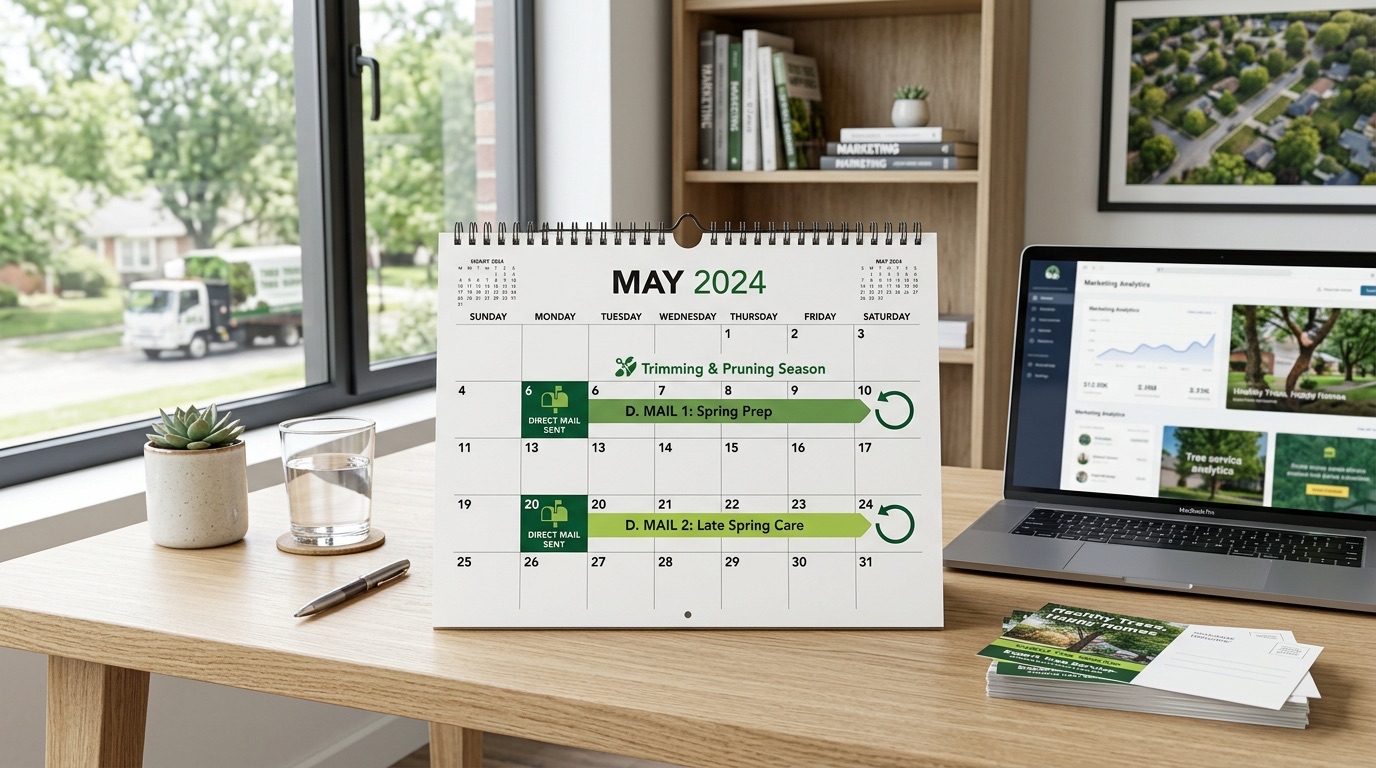
One of the most common questions from tree service owners considering direct mail: how often should I be mailing?
The short answer is monthly. But the reasoning behind that answer matters, because understanding why monthly is right also tells you when to mail more and when less frequent mailing will hurt you.
Direct mail produces results through frequency, not through a single exposure. Marketing research consistently shows that consumers need 3-7 impressions from a message before they act on it. The first time a homeowner sees your letter, they register it. The third time, they might read it. The fifth time, that’s when the homeowner who’s been meaning to deal with that dead oak finally picks up the phone.
Monthly mailing at the Growth plan level, two blasts of roughly 2,300 letters each, targeting the same carrier routes, means homeowners in your best neighborhoods see your letter every 4-5 weeks. By month 3, they’ve seen it 3 times. By month 6, they’ve seen it 6 times and your name is the first one they think of when they finally make the call.
This is the frequency effect at work. It’s not about any single mailer being brilliant, it’s about consistent repetition that builds brand familiarity and keeps you top of mind in the neighborhoods that matter.
Monthly mailing also drives the optimization cycle. Two blasts per month means route-level data accumulates faster. By month 2, you have enough signal to start cutting dead routes and doubling down on performers. That optimization is what produces compounding results.
Cut the frequency to quarterly and you’re mailing the same households once every 12 weeks. You’ve lost both the frequency effect and the fast data feedback loop. Results stay flat.
Every decrease in frequency costs you something specific.
Bi-monthly (every two months): Homeowners see you 6 times a year instead of 12. Frequency effect is weakened. Brand recall in your target neighborhoods drops. Data accumulates slower, so route optimization takes twice as long. You can run a campaign this way, but you’re leaving compounding results on the table.
Quarterly: Four mailings a year. You’re essentially running seasonal campaigns, not a sustained marketing program. Most homeowners will see you once or twice before needing tree service, not the 5-6 exposures that trigger the highest conversion. Works as a supplement to another lead source, not as a standalone system.
One-time campaigns: This is the “I tried direct mail and it didn’t work” scenario. One blast, some calls, a decent month, and then silence as the effect wears off. The campaign produces zero compounding, zero route data, and zero brand familiarity. Results are baseline, not optimized. That’s why one-time campaigns almost always underperform relative to sustained mailing.
The opposite question: is there a point where more frequent mailing hurts?
Yes. Mailing to the same households every week produces diminishing returns and eventual annoyance. If a homeowner gets your letter 4 times a month, by week 3 it’s going straight into the trash without being read. You’ve spent money on a piece that never had a chance.
The sweet spot for most tree service companies is monthly, frequent enough to stay top of mind, infrequent enough that each letter still gets some engagement when it arrives.
The exception: expanding your coverage. If you want to test new routes in adjacent neighborhoods, mailing those new routes more frequently for 1-2 months can help you build data faster. But this is an expansion strategy, not a substitute for sustained mailing in your established routes.
Within a monthly cadence, there are two windows where bumping your volume produces outsized returns:
February-March (pre-spring rush): The tree service owners who dominate spring are the ones who start mailing 6-8 weeks before peak season. By March, competitors are just waking up and turning on marketing. You already have 3 drops in the ground and homeowners are starting to call. Mail heavier in February to front-load your spring calendar. The spring marketing playbook covers exactly how to time this.
September-October (fall cleanup season): Homeowners are outside again, noticing their trees before winter. Leaf removal, pre-winter pruning, and any removals that homeowners put off all summer start to move. A volume bump in September means you’re top of mind when demand picks back up.
This isn’t about one-off campaigns in spring and fall, it’s about sustained mailing year-round with intentional volume increases in these two windows. The year-round baseline keeps your route data building and your brand present. The volume bumps capture the seasonal demand spikes.
What happens if you miss a month of mailing?
Call volume drops about 2-4 weeks after the missed drop, following the delivery timeline. One missed month is usually recoverable, you resume mailing, calls return within a few weeks, and your route data is still intact.
Two or three consecutive missed months creates a bigger problem. Your brand familiarity fades in the neighborhoods you stopped mailing. Competing tree services may start picking up calls from homeowners who used to see your letter and now aren’t hearing from anyone. Rebuilding that familiarity takes 2-3 months of consistent mailing just to get back to where you were.
This is why consistency matters more than volume. A smaller campaign mailed monthly outperforms a larger campaign mailed quarterly, because the frequency effect and the data feedback loop only work if the cadence is sustained.
The compounding effect only activates when mailing is consistent. Break the cycle and you reset the clock.
This is the part most tree service owners don’t think through. Frequency doesn’t just affect how often homeowners see your letter, it directly affects your cost per call.
Here’s why. When you mail a carrier route for the first time, you’re introducing your brand to people who’ve never heard of you. Call rate is baseline. When you mail that same route again 4 weeks later, some of the homeowners who didn’t call last time remember seeing your letter. The barrier to calling is lower. A portion of them convert now that they’ve seen you twice.
By month 6 in a well-run route, your response rate is often meaningfully higher than month 1 because you’ve built enough familiarity that homeowners who need tree service think of your number before they open Google.
The practical result: your cost per call goes down over time when you mail consistently, even if your spend stays the same. More calls from the same budget, because each letter lands in a mailbox where the homeowner already knows your name.
Drop to quarterly, and you reset the familiarity clock with every mailing. You’re always introducing yourself. You never reach the part of the curve where familiarity compounds into faster conversions.
If you’re planning a 12-month campaign, here’s how to think about the calendar:
Months 1-2: You’re building your baseline. Both blasts go to the same 20 routes each month. You’re collecting call data, not optimizing yet. Don’t judge the campaign on month 1.
Month 3: First optimization cycle. Your account manager reviews the route data from the first two months and cuts the underperformers. You might go from 20 routes down to 14-16, redirecting that budget to your top performers. Cost per call starts to drop.
Month 4-6: You’re running a tighter, more efficient campaign. Homeowners in your surviving routes have seen your letter 4-6 times. Close rates start improving because these are warmer leads. Call volume may hold even though you cut routes, because your remaining routes are producing more per mailing.
September volume bump: Add 3-5 routes temporarily to capture fall demand. Test adjacent routes that match your top performers’ characteristics.
Months 7-12: Mature campaign. Your route data is rich enough to expand confidently or tighten further. Some clients add a second geography at this point because the primary market is saturated with their brand.
This is what a full year looks like when frequency and consistency are both right. It’s not a series of separate campaigns, it’s one system building on itself month by month.
For most tree service companies at $750K+ in revenue:
This cadence produces compounding results because data accumulates monthly, routes get optimized on a regular cycle, and homeowners in your best neighborhoods see your brand often enough to remember it when they’re ready to call.
Want to see what this looks like in your market, including which routes should be getting your first mailings? Schedule a call and we’ll map it out.
Ready to grow into the neighborhoods you want?
250+ tree companies use Tree Traction. See if your zip code is available.
Book a Free Strategy CallFREQUENTLY ASKED QUESTIONS
Monthly is the standard, two blasts per month to specific carrier routes, with each blast covering roughly 2,300 households. Monthly mailing builds brand familiarity, collects consistent route-level data, and benefits from the compounding effect where each month's results inform and improve the next. Less frequently than monthly, and you're losing the optimization advantage.
For tree service, monthly mailing with two blasts per month (approximately 4,600 letters total) is the standard. More frequent than that risks overexposure in the same neighborhoods, homeowners get annoyed if they see your letter every week. Less frequently, and you lose the frequency effect that makes homeowners remember your name when they finally need service.
Research consistently shows 3-7 exposures before a homeowner responds to a direct mail piece. This is why sustained monthly mailing outperforms one-shot campaigns, the first drop plants the seed, the third drop is when most homeowners who were borderline start to call, and the sixth drop captures the ones who finally noticed that tree that needed work.
Yes, volume bumps in February-March (pre-spring rush) and September-October (fall cleanup season) are standard. The idea is to be in homeowners' hands before demand peaks, not after. Companies that bump mail volume 6-8 weeks before spring hit the market when competitors are quiet and bookings convert faster.
Your call volume drops 2-4 weeks after the missed mailing, following the same timeline as delivery. One missed month is recoverable, you resume mailing and calls return. Two or three missed months can break the compounding cycle, require rebuilding brand familiarity in your routes, and let competitors fill the gap in the neighborhoods you went quiet in.
About the Author
Brayden Fielding
CEO, Tree Traction
Brayden Fielding is the founder and CEO of Tree Traction, the only direct mail company in the U.S. built exclusively for tree service businesses. He's worked with 200+ tree service companies across the country, studying what makes direct mail campaigns produce real revenue (and what makes them flop). When he's not digging into route-level data or reviewing campaign results, he's talking to tree service owners about what's actually working in their markets.
KEEP READING
Local SEO for tree service companies: how to rank in Google Maps, build your Google Business Profile, earn reviews, and get found before competitors.
Which videos generate tree service leads and which waste your time. A no-fluff guide to tree service video marketing that actually produces calls in 2026.
Tree service Google Ads vs direct mail: real cost breakdowns, close rate math, and when each channel actually wins for your budget.
Book a free strategy call — 30 minutes, no obligation.
Book a Free Strategy Call