
Strategy 8 min April 16, 2026 Updated May 21, 2026
What Makes a Good Direct Mail Piece for Tree Service Companies?

Brayden Fielding
CEO, Tree Traction
Brayden Fielding
CEO, Tree Traction
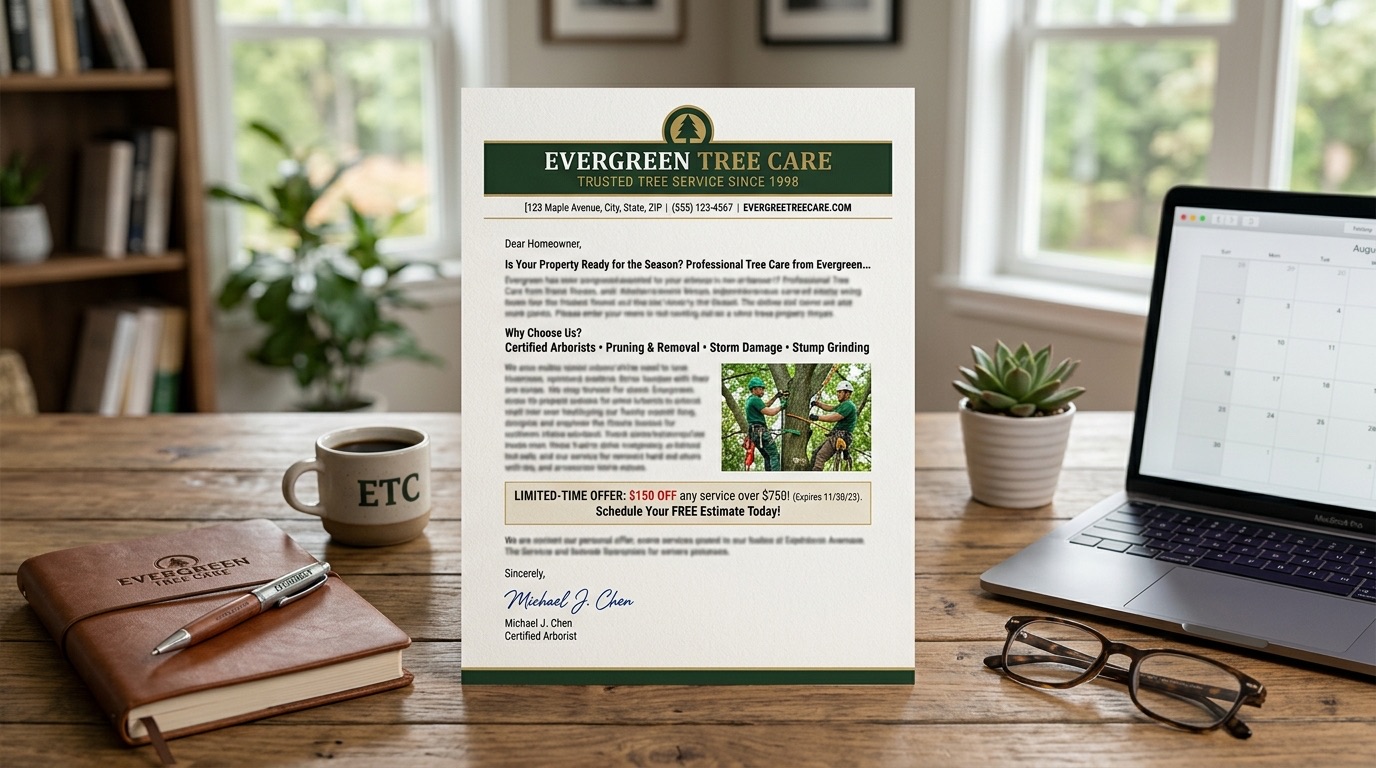
Most tree service mailers look identical. A headline about “professional tree service,” a photo of a tree crew or a stock image, a phone number, and a logo. Maybe a tagline.
They work about as well as they look, fine, but not great. Call rates in the 0.2-0.4% range. Forgettable.
The tree service mailers that produce 0.8-1.5% call rates (2-4x higher) look different. Not dramatically different. But they hit specific elements that the mediocre ones miss.
Here’s what makes the difference.
This is the most important decision and the most frequently wrong one.
Postcards are cheap and fast. They’re also the wrong format for tree service. A postcard competes with every other piece of mail in that homeowner’s stack for 2-3 seconds of attention. If your offer doesn’t immediately grab them, it goes straight into the trash, and most don’t grab anyone.
A full-size 8.5x11 letter sent flat (no envelope) is a different experience. It’s substantial. It requires engagement. Homeowners hold it, unfold it, read it. Letters have a dwell time, they sit on kitchen counters, get shown to spouses, get set aside for “when I have time to call.” Mail stays in homes an average of 17 days. Postcards don’t.
For tree service specifically, a letter format also signals legitimacy. Postcards look like mass-market junk mail. A well-designed letter looks like correspondence from a real business, one that was specific enough to know this homeowner’s neighborhood might need tree service.
Full color, full size, sent flat. That’s the baseline.
The highest-performing tree service letters include something that looks handwritten, not a scrawled signature at the bottom, but a portion of the letter that appears personally written. This could be a handwritten-style header, a handwritten note in the margin, or a signature from the owner that looks like an actual signature.
This element matters because it disrupts the pattern of mass-market mail. The homeowner picks it up and thinks, for even half a second, “did someone write this to me specifically?” That half second of genuine attention is worth more than the nicest printed design in the world.
The key word is “appears.” It’s printed, but the font, the layout, and the placement make it read as personal. Combined with a personalized message (your actual name, your crew’s actual territory), it creates the sense that this letter was sent specifically to their neighborhood by someone who knows it.
Most tree service mailers use one of two photos: a stock image of someone smiling in a hard hat (nobody’s convinced), or a perfectly shot crew photo from a marketing session (respectable but cold).
The best-performing mailer photos are slightly rough around the edges, a real photo of the owner or crew at a job site, candid enough to feel authentic. A selfie-style photo of the owner in front of a job they’re proud of. A crew shot on a real removal in a neighborhood that looks like the neighborhoods being mailed.
Why does this work? Because tree service is a trust business. The homeowner is letting a stranger with a chainsaw into their yard. A real photo of a real person, one who clearly runs the kind of operation the homeowner could feel comfortable hiring, builds that trust faster than any marketing line.
Stock images do the opposite. Homeowners have seen the same smiling contractor stock photo on 40 different home service websites. It reads as anonymous, which reads as untrustworthy.
Use a real photo. Your face, your truck, your crew. It doesn’t need to be perfect, it needs to be real.
“Professional tree removal and trimming services.”
That sentence could describe every tree service company on earth. When a line could appear in any tree service mailer in any market, it produces no response, because it says nothing specific to the homeowner receiving it.
The lines that produce calls are specific:
Specific = credible. Generic = ignorable.
The best-performing letters address a real problem the homeowner might have (storm-damaged branches, a leaning tree, a dead limb over the driveway), offer a concrete reason to call now (seasonal availability, a specific offer, the fact that you’re already in their neighborhood), and make it easy to act (one phone number, clearly stated).
Avoid the “we’ll be in your area” line. It’s the most common line in tree service mail and it’s become meaningless. Homeowners have seen it from dozens of companies. It signals that your letter is generic, which signals that your company might be too.
The worst call to action in tree service direct mail: “Contact us for a free estimate.”
Every company offers free estimates. Saying you do offers nothing differentiating.
The best calls to action are specific and low-friction:
The phone number should be prominent. Not buried at the bottom in small font. Not shared with three other contact methods. One number, large, on a line by itself. Make it obvious and make it easy.
One tracking number per mailer also gives you data on which neighborhoods respond to which calls to action, so you can test variations and improve over time.
A few things that consistently hurt performance:
“We’ll be in your area next week.” Overused and now counterproductive. Skip it.
Too many services listed. A letter that lists tree removal, stump grinding, lot clearing, storm cleanup, emergency response, land clearing, and brush removal reads like a menu, not a letter. Pick the 2-3 services you want to promote and stay focused.
QR codes as the primary CTA. QR codes are fine as a secondary option. But making them the main call to action assumes every homeowner is willing to stop, pull out their phone, and scan. Most won’t. Phone number first, QR code as a supplement.
No clear sender. If the homeowner can’t tell within 3 seconds who sent this letter and what they do, the letter is working against itself. Your business name, a real person’s name, and a local phone number should be immediately visible.
The best mailer you can run today isn’t the best mailer you’ll ever run.
Testing two creative versions (different headlines, different photos, different offers) across different carrier routes tells you what your specific market responds to. The tree service owner in Texas who responds to “storm prep” messaging may be different from the one in Wisconsin who responds to “spring cleanup.” You find out by testing.
With route-level tracking, you can run version A on 6 routes and version B on 6 routes and compare call rates directly. After 2-3 months, you know which version wins. You retire the loser and test a new variation against the winner.
This is how a direct mail campaign improves every quarter, not by guessing what works, but by measuring it against real call data and acting on the results.
See how the compounding effect plays out over the first 6 months, or compare what targeted direct mail looks like vs. EDDM blanket coverage if you’re coming from a less targeted approach.
If you want to see what a well-designed letter for your specific market looks like, schedule a call and we’ll walk you through examples before you commit to anything.
Ready to grow into the neighborhoods you want?
250+ tree companies use Tree Traction. See if your zip code is available.
Book a Free Strategy CallFREQUENTLY ASKED QUESTIONS
Full-size 8.5x11 letters, printed full color, sent flat without an envelope. Letters outperform postcards for tree service because they get read rather than scanned. A letter that looks like it came from a real person in the neighborhood, with a handwritten-style element, a personal signature, and a specific message, produces 3-5x higher response rates than a postcard.
Lead with specificity: a real result, a real offer, or a real story from the neighborhood. Avoid generic lines like 'we'll be in your area', homeowners have seen that a hundred times. The best-performing tree service letters mention specific services (removals, storm prep, stump grinds), include a clear phone number to call, and feel like they were written for that specific homeowner, not mass-produced.
Yes, a photo of the actual owner or crew, not a stock image. A real photo of your team, your truck, or a completed job in a neighborhood like theirs builds credibility fast. Stock photos of generic trees or generic smiling people reduce trust because homeowners can tell the difference. Your face and your crew's faces make the letter feel personal.
One full side of an 8.5x11 sheet, roughly 300-500 words. Long enough to make a compelling case, short enough to get read. Homeowners who are interested will read every word. Those who aren't won't read past line three regardless of length. The goal is to convert the interested ones quickly and clearly.
At minimum, seasonally, 4 times a year. But ideally, you're testing new creative variations every 2-3 months across different routes. Running the same mailer month after month produces diminishing returns as homeowners become familiar with it. A/B testing different messaging, photos, and offers against route-level tracking data tells you which creative drives more calls.
About the Author
Brayden Fielding
CEO, Tree Traction
Brayden Fielding is the founder and CEO of Tree Traction, the only direct mail company in the U.S. built exclusively for tree service businesses. He's worked with 200+ tree service companies across the country, studying what makes direct mail campaigns produce real revenue (and what makes them flop). When he's not digging into route-level data or reviewing campaign results, he's talking to tree service owners about what's actually working in their markets.
KEEP READING
Local SEO for tree service companies: how to rank in Google Maps, build your Google Business Profile, earn reviews, and get found before competitors.
Which videos generate tree service leads and which waste your time. A no-fluff guide to tree service video marketing that actually produces calls in 2026.
Tree service Google Ads vs direct mail: real cost breakdowns, close rate math, and when each channel actually wins for your budget.
Book a free strategy call — 30 minutes, no obligation.
Book a Free Strategy Call