
Growth 10 min April 1, 2026 Updated May 21, 2026
Tree Service Lead Generation: The Complete 2026 Guide

Brayden Fielding
CEO, Tree Traction
Brayden Fielding
CEO, Tree Traction
Carlos Morales with JC Tree Care quoted $40,600 in his first week using targeted direct mail. One week. Before that, he was grinding for every estimate through word of mouth and hoping the phone would ring.
That’s one end of the tree service lead generation spectrum. The other end? Spending $2,000 a month on Angi, driving 45 minutes to give an estimate, and losing the job to the cheapest bid from a guy with a pickup truck and a chainsaw. Same industry, same goal, wildly different outcomes.
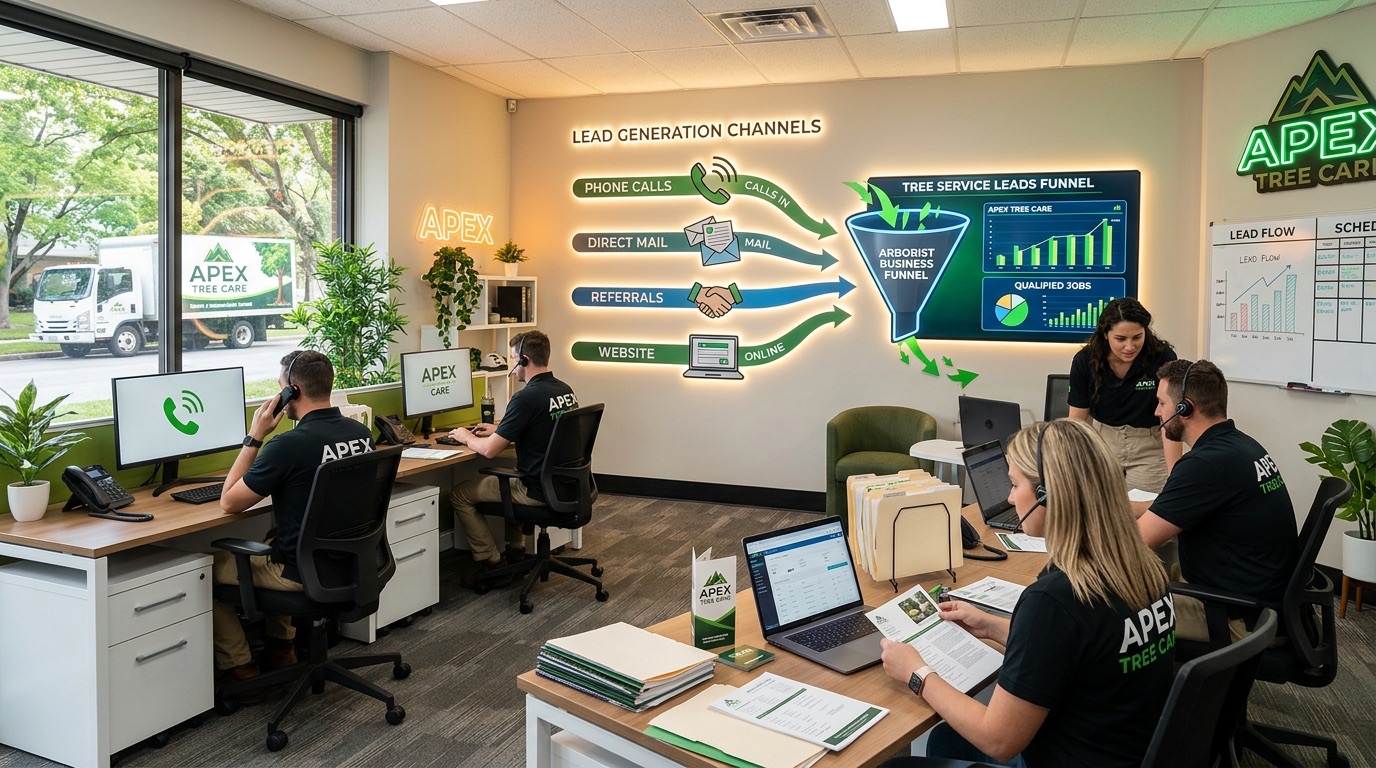
The difference isn’t luck. It’s knowing which lead generation channels actually produce booked jobs for tree service companies, and which ones just produce headaches.
Here’s what we see constantly across 200+ tree service companies: owners who are spending money on marketing but can’t tell you which channel booked their last 10 jobs.
They’ve got Google LSA running. Maybe some Facebook ads. An Angi profile they’re paying for. A buddy who “does SEO.” And the phone rings sometimes. But they have no idea which dollars are producing those calls and which dollars are disappearing into nothing.
That’s not a lead generation strategy. That’s gambling with a marketing budget.
The tree service owners who grow past $750K and then past $1M all have one thing in common. They know their cost per booked job on every single channel. Not cost per lead. Not cost per click. Cost per job that’s quoted, closed, and paid for. Because a “lead” from Angi that also went to four other tree services isn’t worth the same as an exclusive call from a homeowner who only contacted you.
Sound familiar?
Not all leads are created equal. Here’s every major channel tree service companies use to generate work, ranked by what we’ve seen actually produce profitable jobs.
Targeted direct mail lands a physical letter in a homeowner’s hand before they ever search Google or call anyone else. You’re creating demand, not competing for it. And when the targeting is right, the leads are exclusive, geographically clustered, and from homeowners who can actually afford professional tree work.
Matt Morovic with Upright Tree Care 10x’d his marketing spend in his first month. He’s running 5 estimates in 2 hours because they’re all in the same neighborhood. That’s what happens when your mailers are hitting carrier routes selected using tree density data, income levels, and property values rather than just blanket-mailing a zip code.
Typical cost per lead: $25-$60 for exclusive leads. Close rate: 40-50% because the homeowner called only you. Cost per booked job: $50-$150.
The catch? You need route-level tracking to make it work long-term. Without unique tracking numbers on every carrier route, you’re mailing blind. You’ll keep spending on routes that produce nothing and never know it. That’s why 75% of direct mail calls come from just 50% of routes mailed. Cut the dead weight and results compound month over month.
Google LSA still captures the highest-intent leads in the tree service industry. Someone searching “emergency tree removal near me” needs a tree service right now. That intent is real and valuable.
Typical cost per lead: $25-$100 depending on market size. Close rate: 15-25% (leads are now shared with up to 4 competitors via “Get Competitive Quotes”). Cost per booked job: $100-$500+.
The problem? LSA costs have climbed every year since 2020, and Google’s algorithm changes can tank your lead volume overnight with zero warning. The mobile app got killed in early 2025. Manual lead disputes got replaced by AI review in 2024. And that “Get Competitive Quotes” rollout turned exclusive leads into shared ones.
LSA works best as a supplement to a channel you control, not as your only lead source. For the full math, read our LSA vs. direct mail comparison.
Ranking your own website for “tree service [your city]” produces free, exclusive leads. Nobody shares an organic search result with four competitors. The homeowner finds your site, reads your reviews, and calls you.
Typical cost per lead: Effectively $0 per lead once you’re ranking (but $1,000-$3,000/month in ongoing SEO costs). Close rate: 30-40% because they chose you from search. Cost per booked job: Drops over time as rankings stabilize.
The downside is speed. SEO takes 6-12 months to produce consistent results. Algorithm updates (Google rolled out multiple core updates in 2025) can wipe out your rankings overnight. And in competitive markets, you’re fighting national directories and aggregators for page-one spots.
Good for companies who can wait. Not a solution if you need leads next month.
Every tree service owner’s favorite lead source. Referrals close at 50-70% and the customer already trusts you before you show up. No marketing cost, no competition, no tire kickers.
The problem is you can’t scale word of mouth. You can’t tell referrals to show up during your slow season. You can’t double your referral volume when you hire a third crew. And if your referral network is concentrated in one area, you’ve got no way to break into new neighborhoods.
Referrals are the foundation. But if they’re your only lead source, you’re stuck in feast-or-famine mode. Which is exactly why most tree service marketing strategies need multiple channels.
Facebook can generate a lot of leads cheaply. The problem is that “leads” from Facebook are people who were scrolling through vacation photos, saw your ad, and tapped a button. They weren’t looking for tree service. They were bored.
Typical cost per lead: $15-$80. Close rate: 5-15%. Cost per booked job: $200-$600+.
Lead costs have tripled for many home service advertisers since 2024. And the leads you do get skew toward price shoppers, tire kickers, and people looking for free wood. We’ve covered this in detail in our direct mail vs. Facebook ads breakdown.
Facebook can supplement an existing strategy, but building your tree service around Facebook leads is building on sand.
Both platforms send the same lead to 3-5 contractors simultaneously. You’re paying $25-$85 per lead on Angi (BBB rating: 1.08/5) or $15-$40 on Thumbtack, and the homeowner already has multiple quotes before you pick up the phone.
The math just doesn’t work for most established tree services. If 70% of your Angi leads are unqualified and the ones that are qualified are shopping four other bids, your actual cost per booked job climbs to $300-$800. That’s fine for a one-truck operation that needs any work. It’s a losing proposition for a company trying to grow profitably.
There’s a reason tree service owners are leaving Angi in 2026.
These aren’t lead generation channels. They’re brand awareness plays. Yard signs and vehicle wraps keep your name visible, which supports every other channel. A homeowner who’s seen your truck around the neighborhood is more likely to call when your mailer lands in their mailbox.
Cost: Low and one-time. Lead attribution: Nearly impossible. Best use: As a complement to active lead generation, never as a standalone strategy.
Here’s where most tree service owners get tripped up. They compare cost per lead across channels and think the cheapest lead wins. It doesn’t.
A $30 lead from Facebook that never answers the phone costs you infinity per booked job. A $50 lead from direct mail that closes at 45% and books a $2,800 removal costs you $111 per job. Which one would you rather have?
Let’s do the math on a $3,200 monthly budget across three channels:
Direct mail: 50-65 exclusive calls. 95% book estimates, 35-65% close rate. 17-40 booked jobs. Average job: $1,500-$2,000. Revenue: $25,500-$80,000.
Google LSA: 32-128 shared leads. 15-25% close rate. 5-32 booked jobs. Average job: $1,000 (lower because of price competition). Revenue: $5,000-$32,000.
Angi: 38-128 shared leads, 70% unqualified. 10-20% close rate on the rest. 1-8 booked jobs. Average job: $800 (heavy price shopping). Revenue: $800-$6,400.
Same budget. Wildly different outcomes. The difference is lead exclusivity and targeting quality. When you’re the only tree company a homeowner called, your close rate doubles and your average job value goes up because you’re not competing on price.
Notice the word “system.” Not “campaign.” Not “strategy.” A system.
The tree service companies that hit $1M+ in revenue don’t just buy leads. They build a lead generation system where results improve every month because data feeds back into decisions. Here’s what that looks like.
Start with one controllable channel. Pick a lead source where you own the data and can see exactly what’s working. Direct mail with route-level tracking is ideal because you can see which neighborhoods produce calls, cut the dead routes, and reinvest in the winners. Your cost per lead drops over time instead of staying flat.
Add a high-intent capture channel. Once your foundation is producing consistent calls, layer in Google LSA or SEO to capture homeowners who are actively searching. Now you’ve got demand creation (direct mail) plus demand capture (search) working together.
Track cost per booked job on everything. Not leads. Not clicks. Booked, paid jobs. If a channel can’t show you that number, you’re flying blind.
Cut ruthlessly. Alissa Tooley with A&J Specialties quoted $160,800 in three months and closed $69,200 on direct mail. She didn’t get there by spreading her budget across six channels. She found what worked and went all in.
Abraham Adams with Westwood Tree Service increased his income $10,000-$15,000 per month using the same approach. Find the channel producing real tree work. Scale it. Cut the rest.
Every tree service lead generation guide ignores this. But if you’re reading this in November with two crews sitting idle and payroll stress keeping you up at night, you don’t need a “complete guide.” You need calls. This week.
Here’s what we’ve seen work for filling seasonal gaps:
Direct mail actually performs surprisingly well during dormant season. Homeowners are home more, spending more time with their mail, and thinking about the dead branches hanging over their roof. Ricky Folse with Veteran Tree Care got 10 calls in 2 days on his first mailing during the slowest season of the year.
The key is adjusting your messaging. Winter mailers should focus on storm damage prevention, dead tree removal, and dormant pruning rather than general tree service. Homeowners respond when the message matches their current reality.
And start mailing before the slow season hits. If you wait until January to start marketing, you’re already behind. The smart play is ramping up mail in October and November so you’ve got a backlog of estimates heading into winter.
For a deeper look at seasonal timing, check our piece on what to expect in your first 90 days of direct mail.
You can generate 100 leads a month and still go broke if they’re the wrong leads.
Here’s what “wrong leads” look like for a tree service: someone wanting a $150 trim on a shrub their landlord owns. A homeowner who requested quotes from five companies and is picking the cheapest. A person who filled out a Facebook form and doesn’t remember doing it. Someone who wants free wood from your removal job.
Quality comes down to two things: exclusivity and targeting.
Exclusivity means the homeowner contacted you and only you. No competing quotes. No price shopping. No race to the bottom. This is why exclusive leads outperform shared leads by a massive margin on close rate.
Targeting means reaching homeowners who have the income to afford professional tree work and the property to need it. Mailing to a carrier route with 40% tree canopy coverage and median household income of $95,000 produces fundamentally different calls than blasting an entire zip code that includes apartment complexes and new construction with no mature trees.
That’s the difference between generating leads and generating jobs.
Here’s the single biggest mindset shift that separates tree service companies doing $500K from those doing $1.5M: the $500K company buys leads. The $1.5M company owns a system that produces them.
When you buy leads from Angi or Thumbtack, you’re renting someone else’s audience. Stop paying, the leads stop. Leave the platform, you take nothing with you.
When you build a direct mail system with route-level tracking, you own every phone number, every piece of performance data, every insight about which neighborhoods produce $3,000 removals versus $400 trims. That knowledge compounds. Month six beats month one. Month twelve beats month six. And if you ever want to change providers, you take all of it with you.
Ben Howard with Howard Tree Care nearly 4x’d his investment from mailer blasts. That kind of return doesn’t happen on month one. It happens because the system gets smarter every month.
So here’s the question: are you going to spend another year buying leads that someone else controls, or are you going to build something you own?
Want to see which routes would work in your area? We’ll map it out for free.
Ready to grow into the neighborhoods you want?
250+ tree companies use Tree Traction. See if your zip code is available.
Book a Free Strategy CallFREQUENTLY ASKED QUESTIONS
The most effective tree service lead generation combines 2-3 channels. Direct mail provides exclusive, predictable leads as a foundation, while Google LSA or SEO captures high-intent searches. The key is tracking cost per booked job across every channel and cutting what underperforms.
Tree service lead costs vary widely by channel. Google LSA runs $25-$100 per lead. Angi charges $25-$85 per shared lead. Facebook averages $30-$80. Professional direct mail runs $25-$60 per exclusive lead. The real metric is cost per booked job, which ranges from $150-$500+ depending on channel and market.
Two reliable ways: SEO (ranking your own website) and targeted direct mail with zip code exclusivity. Both generate calls where you're the only tree service company the homeowner contacts. Platforms like Angi, Thumbtack, and Google LSA send the same lead to 3-5 competitors.
A tree service running 2 crews needs roughly 40-60 leads per month to stay fully booked, assuming a 40-50% close rate. That breaks down to about 10-15 leads per week. The exact number depends on your average job size, close rate, and how much drive time you're willing to absorb.
The three most common reasons: you're relying on a single channel (so when it dips, everything dips), you're not tracking which source produces booked jobs (not just calls), or you're using shared-lead platforms where 3-5 competitors get the same homeowner. Fix the tracking first, then you'll know what to cut.
About the Author
Brayden Fielding
CEO, Tree Traction
Brayden Fielding is the founder and CEO of Tree Traction, the only direct mail company in the U.S. built exclusively for tree service businesses. He's worked with 200+ tree service companies across the country, studying what makes direct mail campaigns produce real revenue (and what makes them flop). When he's not digging into route-level data or reviewing campaign results, he's talking to tree service owners about what's actually working in their markets.
KEEP READING
Email marketing for tree services works when sent to past customers with the right cadence. Here's how to book repeat jobs without burning your list.
Commercial tree service marketing for HOAs, property managers, and municipalities. How to win recurring accounts with targeted outreach and direct mail.
Expanding a tree service into a new area? Skip the wide blast that burns diesel. Use data targeting and geographic clustering to enter a market tight.
Book a free strategy call — 30 minutes, no obligation.
Book a Free Strategy Call