
Operations 7 min April 16, 2026 Updated May 21, 2026
Why Your Tree Service Estimates Are Scattered (And How to Fix It)

Brayden Fielding
CEO, Tree Traction
Brayden Fielding
CEO, Tree Traction
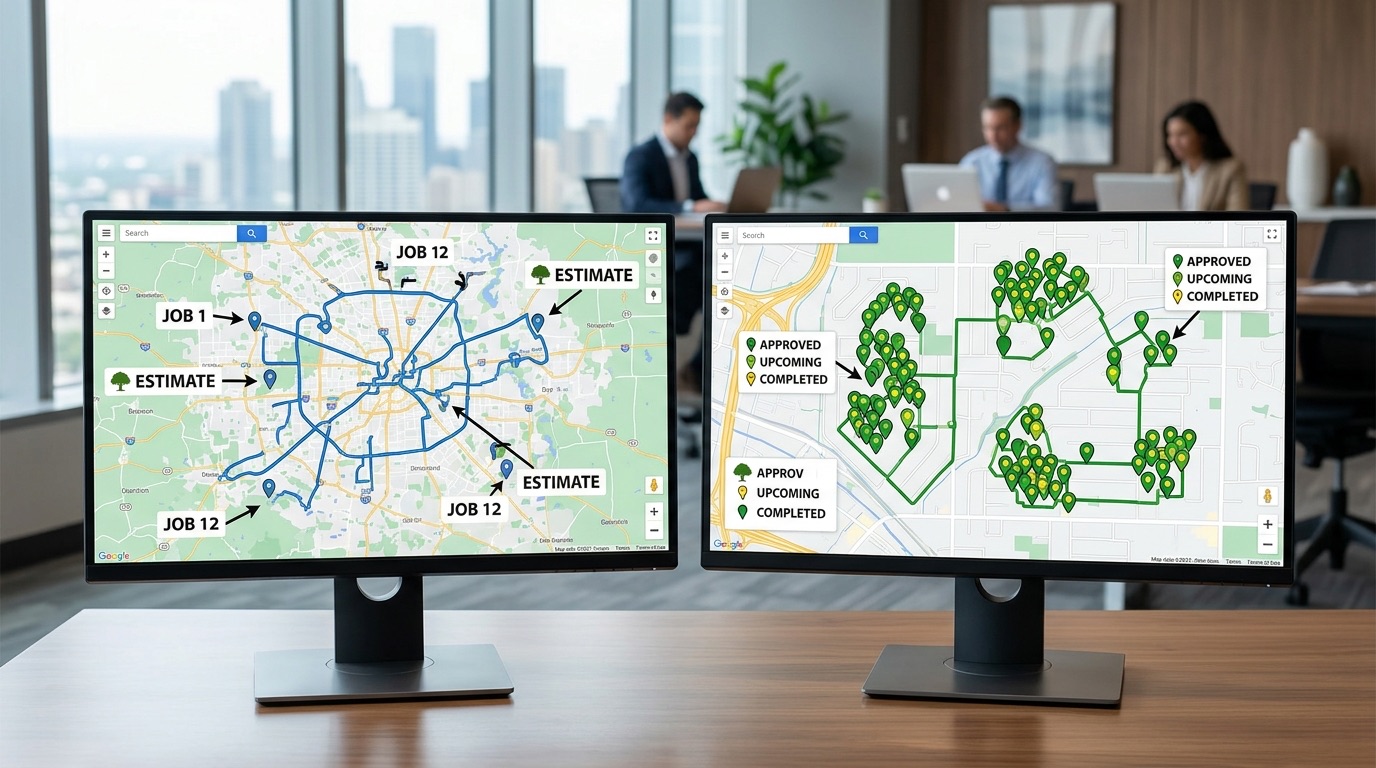
Monday morning. You’ve got 9 estimates on the calendar. One’s up north near the highway. Two are downtown. One’s out past the county line, 45 minutes each way. Another cluster on the south side, but they’re spread across 6 zip codes.
By 3pm, you’ve driven 140 miles, run 6 estimates, missed two because scheduling ran long, and made zero money.
Sound familiar?
This is the scattered estimates problem. And it’s not a scheduling problem. It’s a marketing problem.
Most tree service owners think of scattered estimates as an annoyance. Run the math and it becomes something else.
Say you average 12 estimates per week. If those estimates are spread across 30-40 miles of service area, you’re probably driving 20-30 minutes between each one. That’s 4-6 hours a week in windshield time, just between estimates, not counting the drive to the first one or home from the last.
At a loaded owner rate of $100-$150 an hour (which is what your time is actually worth when it comes to running the business), that’s $400-$900 a week in hidden cost. Every week. $20,000-$45,000 a year.
And that’s before you count the estimates that fall through because you ran behind on a job across town, or the callbacks you missed because you were on the road.
This is why customer acquisition cost matters more than people think. It’s not just what you pay for marketing. It’s what it costs to turn a lead into a closed job, including the hours you personally spend chasing it across the map.
Scattered estimates are a symptom. The disease is scattered marketing.
When you run Google ads, calls come from whoever searches in your area, north, south, east, west, no pattern. When Angi sends you a lead, it’s from wherever the homeowner clicked. When you mail untargeted flyers to an entire zip code, you get responses from all corners of it.
None of these channels give you control over where the phone rings from.
So your leads scatter. And when leads scatter, your estimates scatter. And when estimates scatter, your days look like that Monday morning, 140 miles driven, not much to show for it.
The tree service owners who crack this aren’t better at scheduling. They’re better at marketing. Specifically, they’re targeting neighborhoods (not just zip codes or service areas) and generating calls that cluster geographically by design.
Here’s the shift: instead of figuring out how to schedule scattered estimates more efficiently, figure out how to stop generating scattered estimates in the first place.
That means your marketing needs to target specific neighborhoods, not your whole city. Not every homeowner in a 25-mile radius. Specific streets in specific carrier routes where people have money, trees, and a reason to call you.
When your marketing is that precise, your call volume follows. Calls come from the neighborhoods you targeted. Estimates stack up in the same area. You start running three estimates in an afternoon without driving 10 miles between them.
Matt Morovic with Upright Tree Care in Wisconsin figured this out. He now runs 5 estimates in 2 hours because they’re all in the same neighborhood. He didn’t redesign his schedule, he redesigned his marketing.
That’s the entire fix. Targeted marketing produces geographically clustered calls, which produces geographically clustered estimates. You can’t reverse-engineer it from the scheduling side.
When you’re doing this right, your calendar starts to look different.
Instead of an estimate at 7am in the north end, one at 10am downtown, and one at 1pm past the county line, you’ve got three estimates in the same subdivision, back to back, all within a mile of each other. You drive out once, run all three, and you’re back by noon.
You quote $6,000 at the first house. $2,800 at the second. $1,400 at the third. You’ve closed one job before you’re back in the truck.
Next week, two of those homeowners tell their neighbors. Now you’re getting referrals from a neighborhood where you already have a route strategy in place. The cluster compounds.
This is the operational version of what direct mail does at the marketing level. Route-level tracking tells you which carrier routes are generating calls. You double down on the ones producing, cut the ones that aren’t, and your call volume concentrates in fewer, better-performing neighborhoods. Your estimates start stacking up in the same areas. Drive time drops. Close rates go up because you’re not rushing between jobs across town.
For a deeper look at how route-level data drives this, read How to Get Back-to-Back Tree Service Estimates in the Same Neighborhood.
You don’t have to overhaul everything at once. Here’s how to start:
Pick 2-3 neighborhoods to own. Not your entire service area, specific neighborhoods with the right profile. High homeowner income, lots of mature trees, low renter concentration. These are the routes where your average job value is highest and where one call often leads to three more within a few weeks.
Concentrate your marketing there. Whatever your primary channel is, put more of it into those neighborhoods. If you’re running direct mail, target those specific carrier routes. If you’re running Google LSA, tighten your service area radius. Stop trying to cover everything.
Track where your calls actually come from. This is the step most companies skip. If you don’t know which neighborhoods are producing calls, you can’t double down on the right ones. With route-level tracking, you get a unique phone number per carrier route, so you know exactly which streets are generating volume and which ones are dead weight.
Cut what isn’t producing. Once you have data, stop spending money on neighborhoods that aren’t calling you. That budget goes back into the routes that are working. Your call volume stays the same or goes up. Your coverage area shrinks. Your drive time drops.
This is the cycle that Matt runs now. And it didn’t require buying more trucks or hiring a dispatcher. It required switching from spray-and-pray marketing to targeted, route-level marketing.
Not all neighborhoods are the same. And not all targeting is the same.
Picking routes based on zip codes or eyeballing Google Maps is a guess. You’re looking at a map and hoping the homes on that street have the trees and income to justify a tree service call. Sometimes you’re right. A lot of the time you’re wasting money.
Tree Traction analyzes 295 data points per carrier route, including satellite-derived tree density, canopy health, property values, homeowner age, and home size. That’s not just demographic targeting. It’s targeting the neighborhoods where trees actually exist and homeowners can pay for serious work.
We’re the only company in the country with tree density data at the carrier route level. That means before a single letter goes out, we know which routes have the right combination of trees and money to produce real tree service calls (removals, trims, stump grinds) not tire kickers looking for a $150 quote.
When you start in the right neighborhoods, clustering happens faster. Your first month of mail targets 8-10 high-probability routes. Within 60 days, you know which 4-5 are producing. You concentrate on those. Your estimates stack up in the same area, your crew runs efficient days, and you stop hemorrhaging hours on windshield time.
The business looks different when this works.
Your estimator isn’t burning hours driving. He’s running 4-5 estimates in a 2-hour window and closing 2 of them before lunch. Crew efficiency improves because jobs cluster too, when you’re closing work in the same neighborhoods where you’re marketing, your trucks stop crossing town for single jobs.
Referrals compound faster. When you work the same streets consistently, homeowners see your trucks. Neighbors talk. You become the tree company in that area, not just one of many. Word-of-mouth stops being random and starts reinforcing the geographic concentration your marketing created.
And the feast-or-famine problem gets smaller. When you own specific neighborhoods, you always have a base of volume coming from those areas. You’re not dependent on whoever happened to search Google this week or whatever Angi decided to send you.
That’s the path to a tree service business that actually scales, not chasing leads across a 40-mile service area, but going deep in the right neighborhoods and letting the work stack up.
Want to see which routes make the most sense for your area? We’ll map it out before you commit to anything. Schedule a call here and we’ll show you where the best neighborhoods are in your market.
Ready to grow into the neighborhoods you want?
250+ tree companies use Tree Traction. See if your zip code is available.
Book a Free Strategy CallFREQUENTLY ASKED QUESTIONS
Scattered estimates come from scattered marketing. When you're running Google ads, Angi, or untargeted direct mail across a wide area, calls come from wherever, not from any specific neighborhood. Without geographic targeting in your marketing, you have no control over where the phone rings from.
The fix happens at the marketing level, not the scheduling level. When you target specific carrier routes with direct mail, you generate calls from specific neighborhoods. Over time, your call volume concentrates in those areas, and you start booking multiple estimates on the same block without trying.
It varies, but most tree service owners doing 10-15 estimates per week lose 8-15 hours just in drive time if those estimates are spread across their entire service area. At $100/hour of owner time, that's $800-$1,500 in hidden cost (per week) just from inefficient routing.
Geographic clustering means concentrating your marketing (and therefore your leads) in specific neighborhoods instead of blanket coverage across a wide area. When your marketing targets specific carrier routes, your calls come from those routes, and your estimates stack up geographically so you can run multiple jobs in the same area on the same day.
It's the best channel for it. Direct mail is the only marketing tool where you choose exactly which neighborhoods receive your message. By targeting specific carrier routes with high tree density and homeowner income, your calls come from those areas, not from whoever happened to search Google in a 40-mile radius.
About the Author
Brayden Fielding
CEO, Tree Traction
Brayden Fielding is the founder and CEO of Tree Traction, the only direct mail company in the U.S. built exclusively for tree service businesses. He's worked with 200+ tree service companies across the country, studying what makes direct mail campaigns produce real revenue (and what makes them flop). When he's not digging into route-level data or reviewing campaign results, he's talking to tree service owners about what's actually working in their markets.
KEEP READING
Speed to lead decides which tree service wins the job. Here's the math on response time and why a missed mailer call is a lost job, not a callback.
Most tree service owners send a quote and never follow up. A simple tree service lead follow-up system recovers revenue already sitting in your pipeline.
A month-by-month tree service marketing calendar tying the spring rush, summer peak, fall cleanup, and winter dormant season to specific actions and mail volume.
Book a free strategy call — 30 minutes, no obligation.
Book a Free Strategy Call